



Gnee Steel (Tianjin) Co., Ltd. is one of the most reliable manufacturers and suppliers of galvanised steel floor bar grating in China. Welcome to wholesale customized galvanised steel floor bar grating at low price from our factory. If you have any enquiry about free sample and cheap products, please feel free to email us.
Products Description
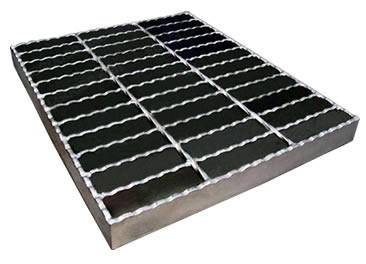
Steel grating, also known as steel bar grating or lattice steel plate, is an open-grid metal floor panel composed of load-bearing flat bars and cross bars welded or mechanically locked at regular intervals. It is designed to provide high strength-to-weight ratio, excellent load-bearing capacity, and free passage of light, air, and fluids, making it ideal for industrial and architectural applications.
Materials & Surface Treatment of Steel Grating
-
Materials of Steel Grating
Mild Carbon Steel: The most common and cost-effective choice.
Stainless Steel (304/316): Used for high corrosion resistance in harsh, humid, or chemical environments.
Aluminum Alloy: Lightweight with good corrosion resistance, suitable for specific lightweight applications.
-
Surface Finishes of Steel Grating
Hot-Dip Galvanized (HDG): Standard outdoor finish; provides excellent anti-rust and anti-corrosion protection.
Electro-Galvanized: Thinner zinc coating for indoor or less demanding environments.
Mill Finish (Raw Steel): Uncoated, for indoor use.
Powder Coated/Painted: Custom colors for architectural aesthetics.
Types of Steel Grating by Manufacturing Method
-
Welded Steel Gratings
Bearing bars and cross bars are fused by resistance welding. Offers exceptional strength and durability for heavy industrial loads.

-
Press-Locked (Swage-Locked) Steel Gratings
Cross bars are mechanically locked into precision notches in the bearing bars. Features a smooth, uniform appearance, ideal for architectural and light industrial uses.

-
Serrated Steel Gratings
Bearing bars have a serrated (toothed) surface for superior anti-slip traction in wet, oily, or high-traffic areas.
Standard of Steel Grating
|
Country |
Standard Name |
Description |
|
China |
YB/T 4001.1-2019 |
Key industry standards, covering dimensions, loads, and manufacturing requirements. |
|
America |
ANSI/NAAMM MBG531-00 |
Widely used in North America for industrial grating |
|
United Kingdom |
BS4592 |
Specifies load ratings and safety for pedestrian use |
|
Germany |
DIN 24537-1 |
German industrial standard for steel grating |
|
Austrilia |
AS1657 |
Covers design and installation of fixed platforms and walkways |
Standard bearing bar spacing includes 30mm, 40mm, 60mm; cross bar spacing is typically 50mm or 100mm .
Common Specifications( Customizable) of Steel Grating
Steel grating size specifications are mainly determined by the dimensions of bearing bars, cross bars, and the overall board size, which can be customized according to actual application scenarios and load requirements. The standard size range and specification representation method are as follows:
Bearing Bar Size: Width (20–75mm) × Thickness (3–10mm).
Bearing Bar Spacing (Pitch): Standard 30mm, 40mm, or 60mm (center-to-center).
Cross Bar Spacing: Standard 50mm or 100mm (center-to-center).
Panel Size: Common width 0.5–1.5m, length 1–6m.
Application of steel grating
Industrial Platforms & Walkways: Used in power plants, petrochemical facilities, and factories
Stair Treads: Often made with serrated steel grating for safety
Trench & Drain Covers: Allows water and debris to pass through; self-cleaning design
Architectural Cladding: Used in facades, ceilings, and sunshades for aesthetic and functional benefits
Container Flooring: Provides ventilation and high load capacity
Mezzanine Floors & Maintenance Platforms: Lightweight yet strong alternative to solid steel plates

Key Features & Advantages of Steel Bar Grating
High Strength-to-Weight Ratio: Strong load capacity while being lightweight.
Superior Ventilation & Light Transmission: Open design allows air, light, and heat to pass through.
Self-Cleaning & Low Maintenance: Does not accumulate dirt, rain, or snow; easy to clean.
Corrosion Resistance: Long service life, especially when galvanized.
Anti-Slip & Explosion-Proof: Safe for industrial and wet environments.
Easy Installation & Dismantling: Convenient for construction and modification.
Aesthetic Appeal: Clean, modern appearance.
FAQ
1. How do I choose the right "Bearing Bar" size and pitch for my load requirements?
Answer: Selection depends on the span (distance between supports) and the type of load (pedestrian vs. vehicular). For example, a 32 x 5mm bar with a 30mm pitch is a standard industrial choice. We provide Load & Deflection Tables to help you determine the exact bar thickness and depth required to ensure structural safety under your specific weight loads.
2. What is the difference between "Serrated" and "Plain" surface grating?
Answer: * Plain Surface: The standard flat-top bar, ideal for most industrial platforms where slip risk is low.
Serrated Surface: Features small notches cut into the bearing bars. This is essential for environments prone to oil, grease, rain, or ice, providing extra grip to prevent workplace falls.
3. Why is "Hot-DIP Galvanizing" better than painted or untreated steel?
Answer: Steel grating is often exposed to harsh weather and chemicals. Hot-DIP Galvanizing (per ASTM A123 / EN ISO 1461) creates a metallurgical bond that protects the steel from rust for 20–50 years. Unlike paint, it won't chip or peel when heavy equipment or foot traffic moves across it.
4. What are the standard "Pitch" measurements (30/100, 40/100, 30/50)?
Answer: These numbers represent the spacing between bars:
30/100: 30mm between bearing bars, 100mm between cross bars. This is the global standard for safety and strength.
40/100: A wider, lighter, and more economical option for areas with less foot traffic.
30/50: Closer cross-bar spacing, often used where higher lateral stability is needed.
5. How do I measure and order "Length" (Span) vs. "Width"?
Answer: This is a common point of confusion.
Length (Span): Always the direction of the bearing bars (the bars that carry the load).
Width: The direction of the cross bars (the rods).
Crucial Tip: Even if the width is longer than the span, the "Length" must always follow the bearing bars to ensure the grating doesn't collapse under weight.
6. Which "Fixing Clips" should I use for installation?
Answer: To avoid welding (which can damage the galvanized coating), we recommend Saddle Clips (Type A, B, or C). These allow for easy removal for maintenance and ensure the grating is securely fastened to the supporting I-beam or angle steel without drilling into the main structure.
Hot Tags: galvanised steel floor bar grating, China galvanised steel floor bar grating manufacturers, suppliers, factory


