



When selecting coated steel for deep-drawing applications, buyers need to consider both the mechanical properties of the steel substrate and the corrosion protection provided by the coating. DC53D+ZM and DX53D+Z are two designations frequently encountered in the coated steel market, but they use different coating systems.
The main difference is that ZM represents a zinc-aluminum-magnesium alloy coating, while Z represents a conventional hot-dip zinc coating. Both can be used with deep-drawing quality steel substrates, but their corrosion protection characteristics differ.
1. What Are DC53D+ZM and DX53D+Z?
DC53D+ZM is a commercial designation used for deep-drawing quality Zn-Al-Mg coated steel. In EN 10346, DX53D+ZM is the corresponding recognized grade designation.
DX53D+Z is a deep-drawing quality steel with a conventional hot-dip galvanized zinc coating.
Both materials are designed for cold-forming operations. Their steel substrates provide the ductility required for drawing and shaping, while their coatings offer different levels and mechanisms of corrosion protection.
The key difference is therefore not simply the steel grade, but the coating technology and its performance after fabrication.
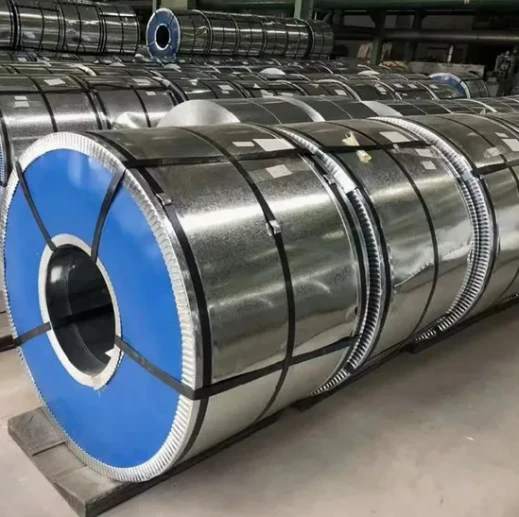
Package of Zn-Al-Mg steel coil
2. DC53D+ZM vs DX53D+Z: Main Differences
| Comparison | DX53D+ZM | DX53D+Z |
|---|---|---|
| Steel Substrate | Deep-drawing quality | Deep-drawing quality |
| Coating Type | Zinc-Aluminum-Magnesium | Zinc |
| Coating Process | Continuous hot-dip coating | Continuous hot-dip coating |
| Corrosion Protection | Enhanced alloy coating protection | Conventional zinc protection |
| Cut-Edge Protection | Improved under suitable conditions | Mainly sacrificial zinc protection |
| Forming Applications | Deep drawing and cold forming | Deep drawing and cold forming |
| Typical Use | Formed parts with higher corrosion demands | General galvanized formed parts |
The mechanical properties of both grades should be checked against the applicable product standard and supplier's test certificate. The coating type alone does not determine forming performance.
4. Is DC53D+ZM Better for Deep Drawing?
Both DX53D+ZM and DX53D+Z use deep-drawing quality steel substrates. Therefore, the forming performance should be evaluated separately from the coating's corrosion resistance.
DX53D is designed for more demanding forming operations than general-purpose commercial grades such as DX51D. It is suitable for applications involving drawing, stamping, bending, and profiling, provided the component design and processing parameters are appropriate.
For manufacturers, several factors should be evaluated before selecting the material:
Drawing Depth and Component Geometry: Deep drawing places considerable demands on material ductility. Buyers should review elongation, plastic strain ratio (r-value), and strain-hardening characteristics when these values are relevant to the forming process.
Coating Adhesion: During drawing and bending, the coating must withstand deformation without unacceptable cracking, peeling, or powdering.
Tooling and Lubrication: Die design, forming speed, clearance, and lubrication influence the final surface quality and production stability.
Post-Processing: Welding, painting, and additional surface treatment may affect the final corrosion performance and should be included in material qualification.
In practical applications, a forming trial using the actual thickness, coating, and tooling is the most reliable way to verify suitability.
5. When Should You Choose DC53D+ZM Instead of DX53D+Z?
The choice depends on the working environment, fabrication process, and overall project cost.
| Application Requirement | Recommended Material to Evaluate |
|---|---|
| General indoor formed components | DX53D+Z |
| Outdoor stamped components | DX53D+ZM |
| Punched and cut formed brackets | DX53D+ZM |
| General galvanized metal enclosures | DX53D+Z |
| Components exposed to frequent moisture | DX53D+ZM |
| Projects prioritizing conventional zinc coating | DX53D+Z |
For outdoor applications, Zn-Al-Mg coated steel may offer advantages in corrosion protection and maintenance requirements.
For indoor components with moderate corrosion exposure, conventional galvanized steel may remain a cost-effective choice.
The best solution should be selected based on the actual service environment rather than assuming that one coating system is always superior.
Frequently Asked Questions
Q1: What is the main difference between DC53D+ZM and DX53D+Z?
The main difference is the coating. ZM is a zinc-aluminum-magnesium alloy coating, while Z is a conventional zinc coating. Their deep-drawing quality steel substrates are designed for similar forming requirements.
Q2: Does Zn-Al-Mg steel have better corrosion resistance than galvanized steel?
Zn-Al-Mg steel generally provides enhanced corrosion resistance compared with conventional galvanized steel at comparable coating conditions. Actual performance depends on coating composition, mass, processing, and exposure environment.
Q3: Can DX53D+ZM replace DX53D+Z?
It may be a suitable alternative when improved corrosion protection is required. However, buyers should verify forming performance, coating compatibility, and application requirements before making a substitution.
Q4: What is the difference between DX53D+ZM and DX51D+ZM?
DX53D+ZM is a deep-drawing quality grade, while DX51D+ZM is intended for general forming. DX53D+ZM is more suitable for applications requiring higher formability.
If you are comparing Zn-Al-Mg steel coil with conventional galvanized steel, GNEE STEEL can help evaluate the appropriate grade, coating mass, and dimensions for your application.
